What happens, however, if people expect that, in the future, the money-supply growth rate will increase to ever-higher rates? In this case, the demand for money would, sooner or later, collapse. Such an expectation would lead (relatively quickly) to a point at which no one would be willing to hold any money — as people would expect money to lose its purchasing power altogether. People would start fleeing out of money entirely. This is what Mises termed a crack-up boom. For More Click The Button Below.
I pledge to chronicle these developments in each article and equip you with the knowledge required to protect and sustain your wealth. Together, we can confront the uncertain future with the certainty that comes from holding assets of unassailable worth.
Central banks persist in the largest financial experiment in history; the Federal Reserve, amongst others, continues to manipulate the yield curve as if curating an exhibit of normalcy in a museum of economic aberrations. Should the fragile dynamic between low-end federal funds rates and yields, such as the 10-year invert or tighten further, the tremors will be felt across markets, signaling that the era of cheap money may has sown the seeds of its destruction. Click The Button Below To Read More!
Regardless of Trump and Elon’s promises to keep the BRICS nations from destroying the dollar – it is clear the Federal Reserve is actively destroying the currency now. Lowering interest rates into rising inflation while the debt market continues to implode is an Econ 101 lesson on what not to do to preserve the purchasing power of a debt-base-theft-currency. To Read More Click the Button Below.
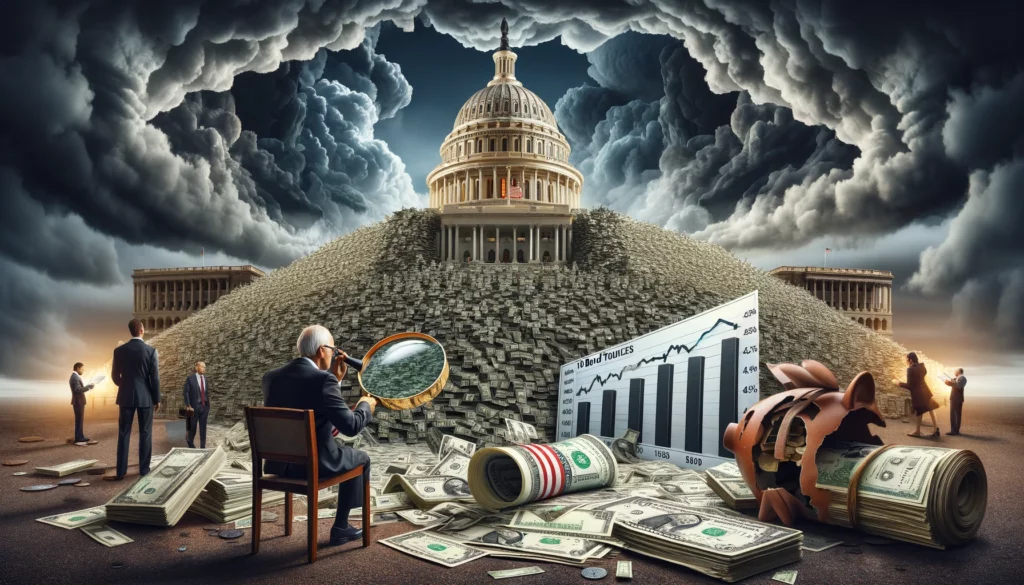
The tapestry of historical financial collapses is rich with lessons; one unequivocal truth echoes through the ages: When sovereign debts reach their zenith, the pillars of the conventional economy are soon reduced to rubble. I iterate to my readership amidst an economy poised on the precipice of pivotal change on the wisdom of transitioning one’s financial portfolio to the bastions of stability—physical precious metals. For More Information, Click The Button Below.
Turning our lens forward, the medium to long-term horizon appears no less fraught. Debt, that ensnaring web spun by spendthrift policies, threatens to suffocate genuine economic activity. Inflation, an insidious tax upon the thrifty, gnaws relentlessly at savings. Interest rates are suppressed to the floor, distorting the delicate balance of savers and borrowers upon which healthy markets hinge. To Learn More Click The Button Below.
The scenario laid out here is not a mere exercise in economic forecasting—it reflects a deeply fractured system. My decades of research and commentary compel me to impart a hard truth: We are likely in the final months of a dollar-based debt currency life cycle. The signs are evident, and history is dotted with the remnants of similar economic declines. An institutional malaise hollows out economies, leaving unprepared populations to grapple with diminished wealth and purchasing power. Click Below to Read More.
Hence, as we brave this ebbing tide of the dollar, we must anchor ourselves with tangible assets. Gold and silver, alongside other precious metals, offer us a lifeline, a chance to ride out the tempest and emerge with our wealth not just intact but potentially thriving. Now is the time to be vigilant, prepared, and act—to ensure that when the tempest subsides, we remain afloat, if not sailing towards new horizons. For More Information Click The Button Below.
The U.S. debt burden paints a grim portrait of the future. The appetite for competitive currencies might shift as we edge closer to a potential pivot in the monetary regime. Cryptocurrencies and central bank digital currencies (CBDCs) may jostle for dominance. Meanwhile, traditional safe-haven assets like gold could regain their luster as investors seek refuge from fiat currency devaluation. For More Information Click the Button Below.
In his latest analysis, Gregory Menorino sheds light on a concerning liquidity crisis. Large commercial banks are increasingly relying on borrowing from the Federal Reserve, while smaller institutions are being overlooked. This suggests a consolidation of power. Menorino advises investing in hard assets to combat the perpetual deficit and warns of persistently high inflation. He criticizes the Federal Reserve’s inaccurate projections and