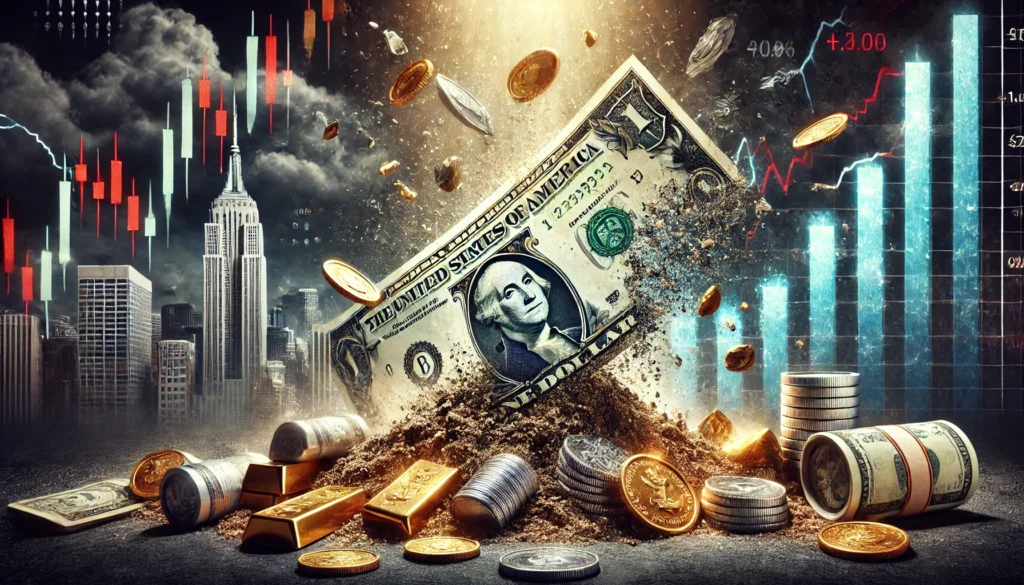

The systemic manipulation witnessed within our economies—distant from free-market principles—leads to a distortion of outcomes; market inefficiencies become not just a byproduct but a defining trait. Manifested through policies distanced from economic reality, these forces occasioned an Opus of financial instability, reverberating through housing, employment, and automotive sectors. Click The Link Below For More Information.
To be on the winning side of the financial system’s transition, it is essential to think like bankers, not investors. The US dollar is under pressure to devalue at an accelerating rate. Central Bankers and their controllers have a schedule, and time is quickly running out. To survive well enough that each of us need not take the first “solution” that is passed out will require that we preserve some of our current wealth – isolate it from being stolen and then use it wisely to ideally bypass the banker’s unconditional surrender demand preventing any further centralize monetary systems coming into existence. Let’s us now look at current conditions. Click The Button Below To Read More.
While insightful, the Federal Reserve Bank’s latest findings underline the painful reality: tariffs and protectionist policies, while politically expedient, impose significant inflationary pressures. Such measures might stoke short-term patriotic fervor but, through an Austrian lens, they possess long-term implications that sacrifice consumer welfare on the altar of nationalistic economics. To Read More Click The Button Below.
In stark contrast to my previous article’s cautionary tone, current trends have only fortified concerns. If unabated, the perennial increase in debt levels prefigures an ineluctable deceleration of economic vigor and a possible collapse of the debt edifice. Heightened by the exuberance in financial markets, the divergence from economic fundamentals to artificially stimulated growth is palpable and perilous. To Read More Click the Button Below.
Given the unreliable nature of fiat currencies and the potential for rapid devaluation, a concerted move toward physical holdings in gold and silver is sensible. Reducing exposure to the debt-laden monetary system acts as a buffer against the looming threats of inflation and market volatility. Pre-1965 coins, which carry intrinsic metal value, are of particular note for their dual role as currency and tangible assets. Click The Button Below for More Information.
What happens, however, if people expect that, in the future, the money-supply growth rate will increase to ever-higher rates? In this case, the demand for money would, sooner or later, collapse. Such an expectation would lead (relatively quickly) to a point at which no one would be willing to hold any money — as people would expect money to lose its purchasing power altogether. People would start fleeing out of money entirely. This is what Mises termed a crack-up boom. For More Click The Button Below.
Today, the Fed will likely lower interest rates again under the guise of economic recovery. However, the truth is far darker than a fabricated rosy picture of the economy. The Federal Reserve is fighting a war to maintain solvency as rising tides of debt are lapping at the shores of a credit crisis. With interest rates rising on their own, the battle becomes maintaining debt face values while undermining the dollar’s purchasing power. These two goals mutually assure the destruction of the dollar-based economy. Click The Button Below For More Information.
Turning our lens forward, the medium to long-term horizon appears no less fraught. Debt, that ensnaring web spun by spendthrift policies, threatens to suffocate genuine economic activity. Inflation, an insidious tax upon the thrifty, gnaws relentlessly at savings. Interest rates are suppressed to the floor, distorting the delicate balance of savers and borrowers upon which healthy markets hinge. To Learn More Click The Button Below.