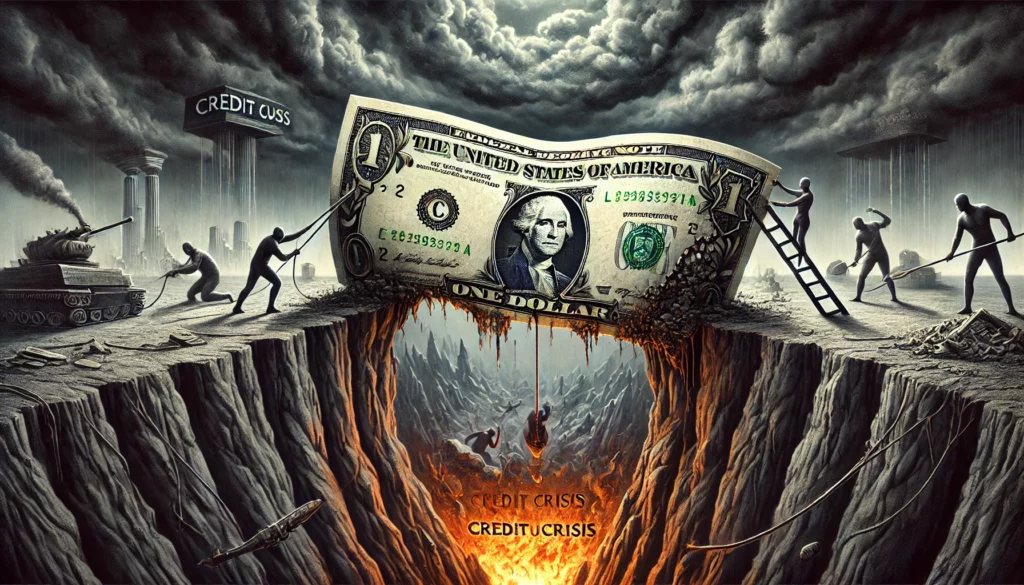
Regardless of Trump and Elon’s promises to keep the BRICS nations from destroying the dollar – it is clear the Federal Reserve is actively destroying the currency now. Lowering interest rates into rising inflation while the debt market continues to implode is an Econ 101 lesson on what not to do to preserve the purchasing power of a debt-base-theft-currency. To Read More Click the Button Below.
The latest moves in the debt market, with sweeping purchases of government bonds, reflect a broader search for security, prompting lower yields on the 10-year Treasury. This trend typically attracts investors toward safer assets during uncertain economic climates. However, the 10-year yield, even after temporary drops, has climbed above 4.5, a significant indicator of a debt market crisis that remains unresolved. To Read The Article Click The Button Below.
Today, the Fed will likely lower interest rates again under the guise of economic recovery. However, the truth is far darker than a fabricated rosy picture of the economy. The Federal Reserve is fighting a war to maintain solvency as rising tides of debt are lapping at the shores of a credit crisis. With interest rates rising on their own, the battle becomes maintaining debt face values while undermining the dollar’s purchasing power. These two goals mutually assure the destruction of the dollar-based economy. Click The Button Below For More Information.
The tapestry of historical financial collapses is rich with lessons; one unequivocal truth echoes through the ages: When sovereign debts reach their zenith, the pillars of the conventional economy are soon reduced to rubble. I iterate to my readership amidst an economy poised on the precipice of pivotal change on the wisdom of transitioning one’s financial portfolio to the bastions of stability—physical precious metals. For More Information, Click The Button Below.
The fundamental attention on the gold-to-silver ratio is warranted, as it has decreased to 83.13 from 86.66 since our last report. This ratio tracks the relative strength of gold-to-silver prices, reflecting how many ounces of silver are required to purchase one ounce of gold. A declining ratio could signal that silver is undervalued relative to gold, which may attract investors seeking value, leading to a bullish outlook for silver. Click The Button Below For More Information.
Turning our lens forward, the medium to long-term horizon appears no less fraught. Debt, that ensnaring web spun by spendthrift policies, threatens to suffocate genuine economic activity. Inflation, an insidious tax upon the thrifty, gnaws relentlessly at savings. Interest rates are suppressed to the floor, distorting the delicate balance of savers and borrowers upon which healthy markets hinge. To Learn More Click The Button Below.
The scenario laid out here is not a mere exercise in economic forecasting—it reflects a deeply fractured system. My decades of research and commentary compel me to impart a hard truth: We are likely in the final months of a dollar-based debt currency life cycle. The signs are evident, and history is dotted with the remnants of similar economic declines. An institutional malaise hollows out economies, leaving unprepared populations to grapple with diminished wealth and purchasing power. Click Below to Read More.
Predictions, therefore, skew towards caution in the face of escalating monetary and fiscal imprudence. As the current trends continue, we will witness a decoupling—precious metals rising as fiat currencies dilute their efficacy amidst sovereign debt crises and inflationary pressures. The equity markets, shouldered by speculators rather than investors, can expect a correction aligned with historical price-to-earnings ratios once the tide of easy money recedes. To Read More Click The Button Below.
Sadly, I see a system being fecklessly dismantled. The fiscal irresponsibility we witness and the egregious oversight in managing the lifeblood of our economy—the US dollar—could lead us to a precipice from which return is impossible. Should the dollar reach the critical stage known as a credit crisis, we will have reached the point of what Austrian economists call the “Crack Up Boom.” Click The Button Below For More Info.
Significant government debt purchases impact bond yields and signal potential shifts across multiple sectors, including housing, commodities, precious metals, and cryptocurrencies. A host of key market indicators and macroeconomic policies are poised to influence the dollar’s valuation. We guide investors to navigate the current landscape, emphasizing prudent investment strategies. Click The Button Below To Read More.